A short reflection from my training program
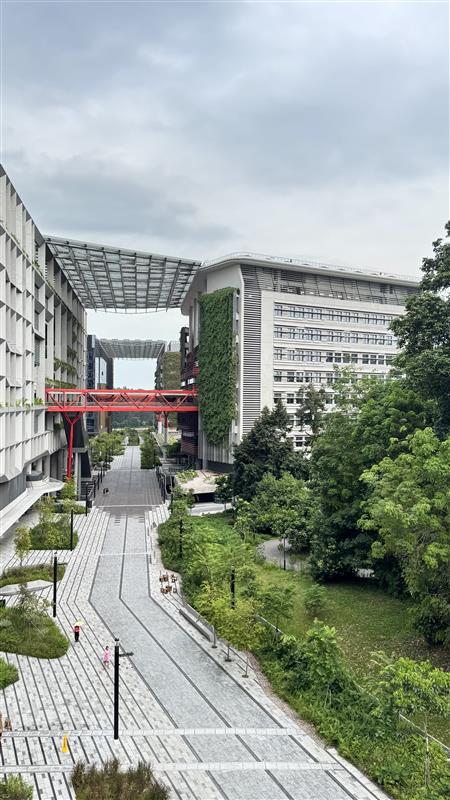
Yesterday, I had the opportunity to visit Punggol Digital District (PDD) — Singapore’s flagship smart district — and it turned out to be one of the most inspiring learning moments of my program. I had read about PDD before, but seeing it firsthand brought a completely different level of appreciation.
1. A Smart District — Not Just Smart Buildings
Many cities talk about smart homes or smart buildings, but PDD is a smart district, which is fundamentally more complex.
It is a coordinated ecosystem of infrastructure, data, operations, and community services working together across a shared digital backbone. This requires multi-stakeholder collaboration across:
- JTC (infrastructure & district development)
- SIT (education & industry partnerships)
- GovTech
- Private industry tech partners
- Startups and research institutes
The scale and integration go far beyond anything a single building can achieve.
2. Digital Twins: Before, During, and After
One of the most impressive aspects was how deeply Digital Twin technology is embedded throughout the district lifecycle:
- Before (Planning):
Urban planners simulate traffic, energy flows, pedestrian movement, security zones, and building interactions long before breaking ground. This reduces design errors, speeds approvals, and optimizes land use. - During (Construction):
Real-time BIM integration and sensor data allow teams to track progress, detect deviations, coordinate contractors, and improve safety and productivity. - After (Operations):
The district continues to operate on its digital twin — enabling predictive maintenance, energy optimization, incident simulation, and “what-if” scenario testing.
The digital twin becomes a living, continuously updated model powering decision-making.
This is where the future of urban management is clearly heading.
3. Smart District OS — The Brain of PDD
What truly enables PDD to function as an ecosystem is the Smart District Operating System (OS) — a unified platform that connects thousands of IoT devices, systems, and robots.
Some real examples that impressed me:
- A delivery robot can communicate with the lift system to request access to different floors.
- Energy, cooling, and power systems all feed into the same OS for optimized efficiency.
- CCTV, access control, waste management, and environment sensors share data to inform district-level decisions.
- Robotics, autonomous vehicles, and campus services operate cohesively instead of in silos.
Instead of isolated “smart solutions,” PDD has a shared operating system enabling interoperability and automation across the entire district.
4. Massive IoT Infrastructure
The district is built on a dense layer of:
- IoT sensors and meters
- Building automation systems
- Service robots
- Autonomous mobile robots (AMRs)
- Edge and cloud analytics
These devices communicate through a central integration platform — no fragmentation, no isolated systems.
This level of integration allows the district to run with real-time situational awareness.
5. Sustainability as a Core Design Principle
PDD is designed for zero-carbon, low-energy operations:
- Centralized cooling
- Renewable energy integration
- District-level energy optimization
- Waste-to-resource concepts
- Green mobility and pedestrian-first design
Sustainability here is not a feature — it is the foundation.
6. An Open Testbed Ecosystem
One thing I admire greatly is PDD’s philosophy of openness.
They provide testbeds for 3rd-party providers to experiment, certify, and integrate their devices or solutions into the district.
This accelerates innovation and brings startups, academia, and enterprises together into a shared ecosystem of collaboration.
7. A Living Ecosystem: Education × Industry × Innovation
PDD combines:
- SIT university campus
- Industry R&D labs
- Startup spaces
- Residential and lifestyle zones
It is designed as a vibrant environment where students, researchers, and companies co-create solutions, experiment, learn, and commercialize innovations.
8. Where Hitachi Fits: IT × OT × AI + Urban Domain Expertise
As I walked through PDD, I couldn’t help thinking:
Hitachi has the full capability to build something of this scale.
With our strengths in:
- IT × OT × AI convergence
- Urban, mobility, energy, and building expertise
- Lumada 3.0, HMAX, and end-to-end integration platforms
- The True One Hitachi approach across digital, engineering, and operations
We are able to support governments and city developers to design, build, and operate next-generation smart districts — just like PDD, or even more advanced.
Final Thought
This visit reminded me that the future of cities will not be built by isolated technologies.
It will be shaped by ecosystems, shared platforms, and collaboration across disciplines.
Punggol Digital District is a living example of what happens when vision, technology, and partnership come together — and I’m grateful for the chance to witness it firsthand.


